


Air pressure is one of those things that feels optional until you are twenty miles from a compressor with a tire going flat. For a Jeep, the compressor has a second job too: airing down for traction on sand or rock and then airing back up for the highway. Those two jobs have different requirements, and the machine that does both well is not the cheapest one on the shelf.
CFM, not PSI
Every compressor quotes a maximum pressure, usually 150 PSI. What matters when you are inflating a 33 inch tire from 15 to 32 PSI is flow, measured in cubic feet per minute. A compressor that delivers 1 CFM takes many minutes per tire; one that delivers 3 CFM takes a couple of minutes per tire, which is the difference between a routine task and an hour on your knees.
Power source decides everything
- Battery-powered units share a tool platform and need no wiring
- Corded 12 volt units plug into the accessory socket and are slow
- Direct-to-battery clamps deliver more current and faster fill
- Engine-driven or CO2 systems are for serious off-road use
If you already carry a battery platform, the cordless route is convenient. If you air down regularly, a compressor with alligator clamps on the battery posts outperforms anything plugged into a cigarette lighter, because the socket is current-limited.
Duty cycle and heat
Most portable compressors are not rated for continuous duty. Four tires in a row is a long run for a small unit, and the cylinder head gets hot enough to burn a hand. Look for a stated duty cycle and honor it. A compressor that shuts down thermally in the middle of a trip has failed at the only job it had.
What to look for
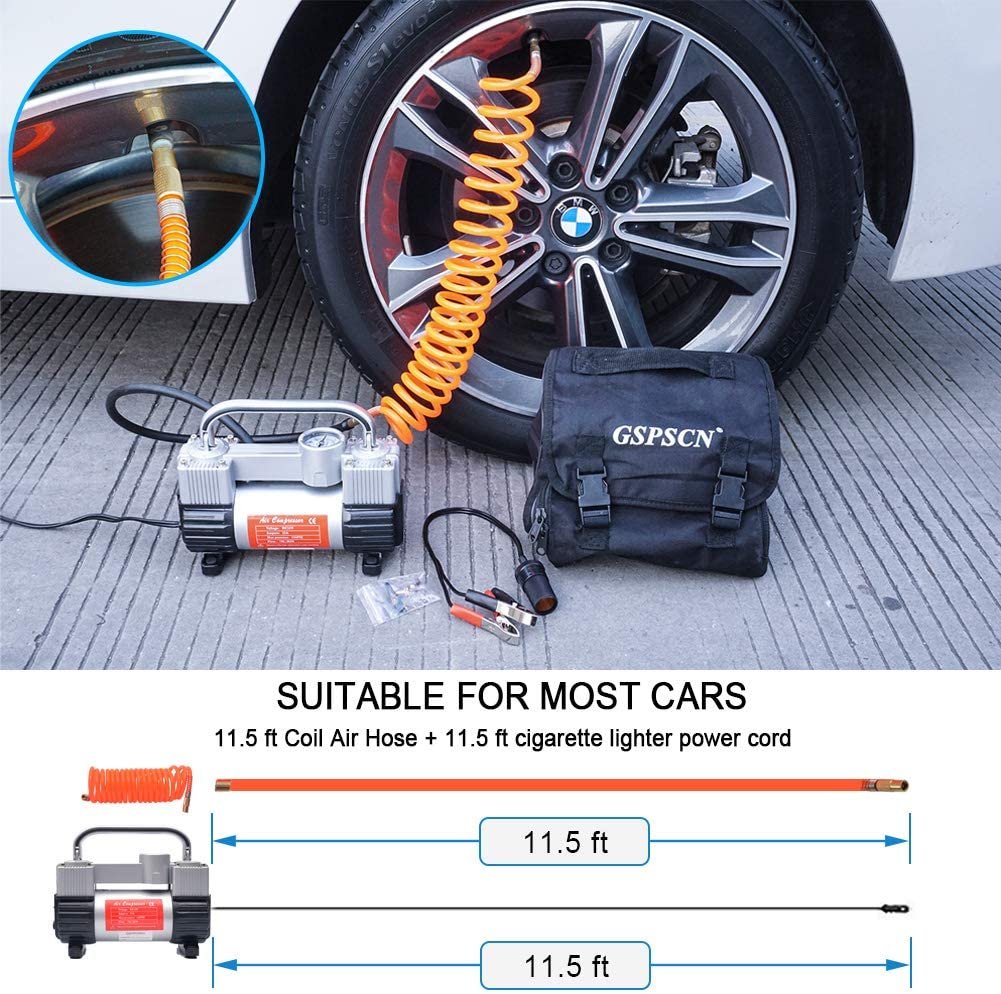
Check for a screw-on or quick-connect chuck that stays put, a hose long enough to reach all four corners from one parking spot, an inline gauge you can read in sunlight, and a carry bag that survives being thrown in a trunk. A built-in light is genuinely useful on a dark trail; a digital preset is nice but not decisive.
Practical use
Air up with the engine running so you are not draining the battery, and check the pressure with a separate gauge, because inline gauges are frequently optimistic. Let the compressor cool between tires in hot weather. Store the hose coiled without kinks; a pinched hose is the most common cause of a slow fill that gets blamed on the pump.
For a comparison of units that hit the flow rates needed for oversized tires, this roundup of portable air compressors for Jeep tires covers the trade-offs between battery, clamp and 12 volt options.
Bottom line
Buy on CFM at the pressure you actually need, power it from the battery posts if you can, and respect the duty cycle. A modest compressor that finishes four tires without shutting down is worth more than a bigger one that overheats halfway through the second.
Tire size changes the maths
A thirty three inch tire holds roughly twice the air volume of a stock thirty one, and the difference grows with width and load range. That means the same compressor takes twice as long to move from fifteen to thirty two psi, which is why a unit that felt adequate on a stock vehicle feels hopeless on a built one. Calculate the volume, then read the flow rating, and you will not be disappointed in the driveway.
Hose length and reach
You need to reach all four corners from one parking spot, and you do not want to move the vehicle with the compressor still connected. A five metre hose is the practical minimum on a long wheelbase; eight metres is better. Check the fittings as well, because a cheap quick coupler leaks and converts a fast compressor into a slow one. Carry a spare coupler and a roll of thread tape.
Heat and duty cycle
Small compressors are not rated for continuous duty, and airing up four tires in a row is a long run. The cylinder head gets hot enough to burn a hand, and thermal shutdown in the middle of a trip is the most common failure. Let the unit idle between tires in hot weather, and mount it where air can move around the fins rather than tucked behind a seat.
Power source in practice
- Battery units are convenient and share a platform, but lose capacity in cold weather
- Twelve volt socket units are current limited and slow
- Alligator clamp units draw from the battery directly and fill fastest
- Hard-wired units need a fused circuit and permanent mounting
If you already carry a cordless platform, the battery route is the one you will actually use, because convenience decides whether the tool comes along. If you air down every trip, the clamp route saves real time.
Gauge accuracy and pressure targets
Inline gauges on portable compressors are frequently optimistic by several psi. Carry a separate stick gauge and trust it. Air up to the vehicle manufacturer pressure for the load you are carrying, which is usually lower than the sidewall maximum, and remember that pressure rises as tires warm on the highway. Set pressures cold.
Storage and maintenance
Coil the hose without kinks, keep the chuck clean, and check the drain if the unit has a tank. Store the compressor where it will not be crushed by cargo, and test it before a long trip rather than discovering a failed unit at the trailhead.
What to carry with the compressor
Pack a separate stick gauge, a spare quick coupler, thread tape and a short extension hose. Those four items cost less than a tow and turn a slow fill into a reliable one. Check the compressor before every long trip, because a unit that sat for months may crank slowly or not at all, and roadside diagnosis is much harder than a two minute test at home.