
Why seeding by hand wastes more than seed
Broadcasting seed by hand is fast and free, and it produces exactly what you would expect: clumps where your hand moved slowly, bare gaps where it moved quickly, and a thinning job two weeks later that costs more time than the sowing saved. A seeder exists to fix one specific problem. It meters seed at a consistent rate and drops it at a consistent spacing, and consistency is the whole reason a row comes up evenly.
What separates one garden seeder from another is not the number of seed plates in the box. It is how accurately it meters small seed, how well it keeps depth constant, and whether you can actually push it through soil that has not been sieved.
Row seeders, broadcast spreaders and drill seeders
These are three different tools and they get conflated constantly.
- A row seeder or push seeder drops seed in a single narrow line at a controlled spacing. This is what most vegetable gardeners mean by a seeder.
- A broadcast spreader throws seed across a wide band and is intended for lawn seed and fertiliser, not vegetable rows.
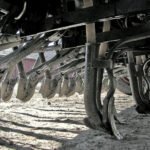
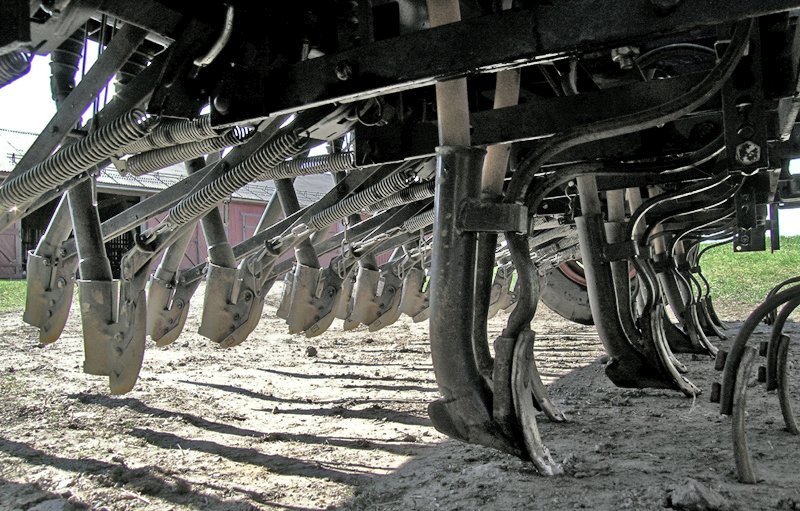
- A drill seeder is a wider implement that plants several rows at once, usually tractor or walk-behind mounted, and is aimed at field scale.
Buying a broadcast spreader when you wanted to plant carrots in rows is the most common mistake in this category, because the two look similar in a catalogue and behave completely differently in the garden.
How the metering works
Most garden row seeders use one of three metering systems.
The first is a seed plate or disc with holes sized for a particular seed. You swap plates for different crops. Plates are simple and durable, and the limitation is that a plate sized for one seed will over or under feed a differently shaped seed of similar size. Round seed meters well; flat or irregular seed like spinach and coriander meters badly.
The second is an adjustable brush or foam roller that wipes seed off a rotating drum. These handle a wider range of seed sizes without swapping parts, which is a genuine advantage if you plant many crops. They are more sensitive to seed quality, because chaff and broken seed clog the brush.
The third is a cup or spoon chain that scoops seed from a hopper. These are common on precision seeders and give excellent spacing for large seed like beans, peas and corn, while being poor for very fine seed.
Seed size is the deciding factor
Be honest about what you actually plant. If your garden is mostly carrots, lettuce, radish and brassicas, you need a seeder that handles fine seed precisely, which usually means plates or a fine metering roller with a very small opening. If you plant beans, peas, corn and squash, a cup-type precision seeder will serve you far better and will plant at a spacing you would otherwise do by hand.
Many gardeners end up buying one seeder for fine seed and planting large seed by hand, because large seed is easy to space by hand and fine seed is not. That is a reasonable compromise and worth considering before paying for a machine that claims to handle everything.
Depth control and press wheels
Depth control is where cheap seeders fail visibly. Seed germinates over a fairly narrow depth band, and a seeder that varies between a quarter inch and two inches will give patchy emergence that looks like bad seed rather than bad machinery.
A good seeder keeps the furrow opener at a fixed depth relative to the soil surface, and closes the furrow with a press wheel that also firms the soil over the seed. Soil-to-seed contact is what starts germination; a furrow left open dries out, and a furrow firmed too hard crusts over and stops the shoot.
Look for a depth adjustment that moves the opener relative to the wheels, not one that only changes the handle height. And look for a press wheel that is adjustable or at least well matched to the soil you have. On heavy clay, a narrow press wheel does less damage than a wide one.
Handles, wheels and pushing effort
You will push this machine walking backwards and forwards for an hour. Handle height and grip shape decide whether that is pleasant or painful, and a single wheel design is easier to steer along a string line than a two wheel design because it pivots. Two wheel seeders are more stable across uneven ground but harder to keep on a straight row.
Wheel size matters more than it looks. A small hard wheel sinks into freshly tilled soil, which changes the depth the opener runs at and defeats the depth setting. A larger wheel with a wider rim rolls over loose soil instead of ploughing into it.
Markers, spacing and straight rows
A row marker is a small feature with a large effect on how the garden looks. It is usually a disc or a skid that leaves a faint line showing where the next row goes. Without one you will end up with rows that converge and diverge, which makes weeding and harvesting harder all season.
Row spacing is set by how you arrange the marker or by the width of the machine. If you plant in raised beds with fixed widths, check that the seeder’s natural row spacing matches your bed so you are not planting one row where two would fit.
Hopper size and seed handling
A large hopper means fewer refills but more seed wasted when you misjudge. A small hopper means refilling every row. For a home garden, the practical range is a hopper that holds enough for two or three rows of the crops you plant most.
Check how the hopper empties. Seed that sits in a corner and never reaches the metering opening will give you a bare patch at the end of every row. A hopper with sloped sides and an agitator is worth paying for.
Cleaning and storage decide next season
- Empty the hopper completely after every use. Leftover seed attracts insects and rodents.
- Brush out the metering mechanism; a single jammed seed can bend a plate or stall a roller.
- Wipe metal parts and oil the axle at the end of the season.
- Store plates and rollers in one place, because losing the plate you need next spring is common.
- Keep the manual. Seed plate charts are hard to replace later.
If you want the specific models compared on metering type, depth control and how well they handle fine seed, the round-up of the best garden seeder options covers those points directly.
Calibrating the seeder before you trust it
Never plant a full row with a setting you have not tested. The reliable method is to measure a known length of ground, set the metering to a starting position, and count what comes out. Run the seeder along ten feet of a path with the opener raised so seed falls onto a sheet, then count or weigh the seed collected and compare it to the rate on the seed packet. Adjust the metering a little and repeat once. Two minutes of calibration prevents the two most expensive outcomes in a vegetable garden: a row so thick it has to be thinned for an hour, and a row so thin that half the bed is bare.
Do this separately for each crop, because the same setting that is right for radish will starve carrots. Write the setting down on a card and keep it with the plates, since you will not remember it next season.
Four common problems and their causes
- Seed drops in bursts rather than steadily: the metering opening is too small for the seed, or chaff is bridging the hopper.
- Bare patches at the end of a row: the hopper outlet is not sloped enough, so seed sits in a corner.
- Rows are too deep or too shallow: the depth control is set against the handle rather than against the wheels, or the wheels are sinking into loose soil.
- Seed comes out crushed: the plate or roller clearance is too tight, or the seed is damp and soft.
All four are setting or maintenance issues rather than defects, and all four are quick to correct once you know where to look.
Soil preparation decides how well a seeder works
A seeder is only as good as the tilth it runs through. Lumpy, unraked soil forces the opener up and down, which changes depth metre by metre and gives patchy germination that looks like a machinery fault. Rake the bed level, break the clods, remove stones larger than the depth you intend to plant, and firm the surface lightly before sowing. On a well-prepared bed, even an inexpensive seeder holds depth well. On a rough one, even an expensive seeder struggles.