


What bladeless actually means
A bladeless tower fan still moves air with a fan. The impeller is hidden in the base, and the visible ring is a shaped slot that pulls surrounding air along with the jet it produces. The manufacturer’s claim that the output is amplified is true in a narrow sense: the slot entrains air from behind and around the ring, so more air leaves the front than the impeller alone pushes. The practical result is a broad, smooth column of air with no visible blade, which is genuinely pleasant to sit in front of.
What that design also means is that a bladeless fan does not automatically move more air than a conventional fan of the same power. It moves air differently. Understanding that difference is the whole buying decision.
Wind speed, airflow and why the numbers mislead
Retail listings quote metres per second, sometimes at the highest setting, measured at the outlet. Outlet speed tells you how fast the air leaves the machine. It does not tell you how much air reaches you across a room, because a fast narrow jet decays quickly, while a slower wider column can feel stronger at three metres.
Useful questions instead of the headline number:
- How wide is the slot? A taller slot produces a deeper column of air, which feels better when you are standing up.
- How many speed steps are there? Five or more lets you find a setting that is comfortable rather than either nothing or a gale.
- Does the rating apply at the highest speed only? If so, assume the comfortable middle setting moves roughly half of it.
Noise is the real reason to pay more
People buy bladeless towers because of the shape, the safety and the smoothness of the airflow. They keep them because they are quiet. A conventional fan chops air into a pulsed stream and the blades produce a blade-pass noise that many people find irritating over hours. A well-damped bladeless tower produces a low whoosh with far less tonal content.
Noise is where budget models show their limits. A cheap bladeless fan often matches a cheap bladed fan for sound at the top speed, because the impeller and the duct are not well damped. If quiet operation is the point of the purchase, listen to the machine at the middle speed, not the lowest, and not the highest.
Oscillation, coverage and placement
Oscillation angle decides how much of a room the fan serves. A narrow sweep concentrated on one seat is what you want for a sofa or a desk. A wide sweep of nearly 180 degrees distributes air across a room but spends less time pointed at you.
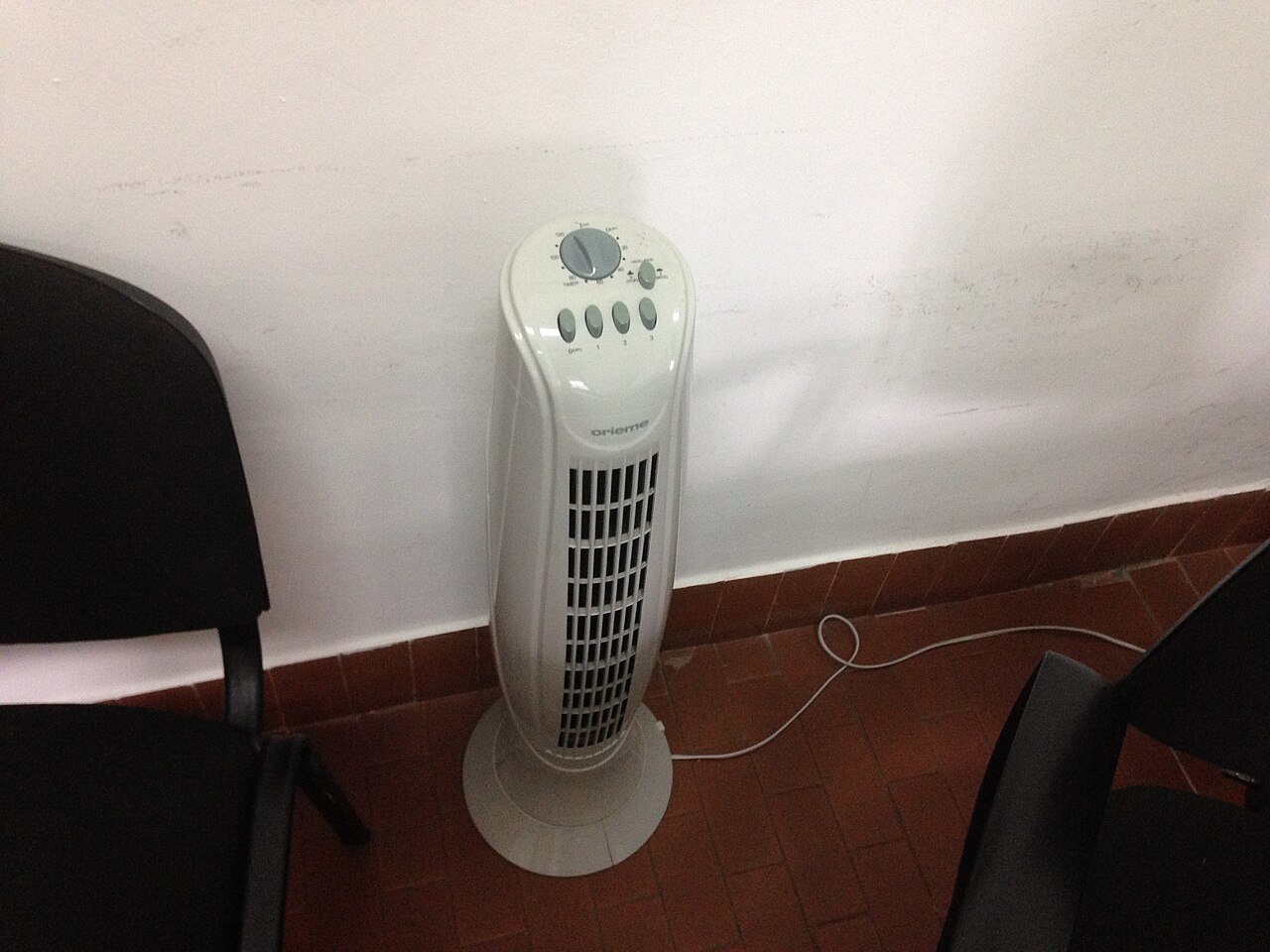
Placement matters more than most buyers expect. A tower fan pulls air from the base, so it needs clearance behind and underneath. Pushing it flat against a wall or into a curtain reduces the airflow it can entrain, which is why the same fan can feel weak in one spot and strong in another. Give it a hand’s width of clearance all round and put it at the far end of the room, angled slightly up, so the column travels across the space instead of colliding with the floor a metre away.
Filters, dust and the maintenance nobody mentions
An internal impeller means internal dust. Air is drawn in at the base, and every particle that is not filtered ends up coating the impeller and the inside of the duct. That build-up is quiet and invisible at first, then it reduces airflow and adds an unbalanced rumble.
Some towers include a washable pre-filter, and those are far easier to live with than sealed units. If the machine has no accessible filter, the base has to come apart periodically. Before buying, check whether the base opens with a few clips or requires screws, and whether the manufacturer publishes a cleaning procedure at all. A fan you cannot clean is a fan that gets weaker every summer.
Controls, timers and sleep modes
For night use, the features that matter are a display that can be switched off or dimmed, a sleep mode that steps the speed down over the evening, and a timer that actually stops the fan rather than only muting it. A remote is useful because the fan is usually across the room; a magnetic dock on top of the unit is the difference between keeping the remote and losing it.
Safety and households with children or pets
The obvious appeal of a bladeless design is that there is no exposed blade for a child to reach into or a cat to investigate. That advantage is real, but it is narrower than the marketing suggests. The base still contains a spinning impeller, and the intake grill has to be small enough to keep fingers and tails out. Check the grill pattern rather than assuming the word bladeless covers everything.
Also consider tip resistance. Towers are tall and light, and a bumped tower that falls over is more of a risk to a toddler than a spinning blade ever was. A weighted, wide base and a low centre of gravity are worth more than a slightly lower price.
Room size and realistic expectations
- Small bedroom, one occupant: a compact tower with a narrow sweep is plenty.
- Living room with several seats: a taller unit with wide oscillation and good clearance behind it.
- Open plan space: a tower fan will not condition the whole area; expect it to create a comfortable zone rather than a cooled room.
- Hot, still, humid days: no fan lowers air temperature. It moves air across your skin, which helps you lose heat, and that only works while you are in the airflow.
What to check before buying
- Several speed steps, with a genuinely quiet middle setting.
- Adjustable oscillation, not just on or off.
- Accessible washable pre-filter, or a base that opens without tools.
- Display that can be turned off for sleeping.
- Stable base and a reasonable weight for the height.
- Remote with a storage dock, plus a timer that really stops the unit.
If you want the current models compared on quietness, airflow and cleaning access, the summary of the best bladeless tower fan options sets out the differences in one place.
Seasonal storage and end-of-summer care
A tower fan spends most of the year in a cupboard, and that is when the dust settles inside it. Before putting it away, run it for ten minutes to clear loose dust, wipe the intake grill, and if the base allows it, vacuum the impeller through the intake rather than blowing air through it. Blowing compressed air into a tower fan pushes dust further into the duct and onto the motor.
Store it upright rather than lying down, because a tower resting on its side can distort the duct and put pressure on the ring where it joins the base. Cover it with a cloth bag rather than a sealed plastic one, since a trapped damp atmosphere encourages corrosion on the metal parts of the base.
Before the next summer, run it on the highest setting for a minute and listen. A new rattle or a rumble that was not there last year usually means a bearing is dry or something has come loose inside, and both are easier to deal with before the first hot night rather than during it.
How a tower fan compares with the alternatives
- Pedestal fan: cheapest way to move a lot of air, and the most effective in a large room, but it takes floor space and looks industrial.
- Floor or box fan: strong airflow and easy to clean, and many people find the noise unpleasant at close range.
- Ceiling fan: moves air across a whole room at very low noise, and is by far the most efficient option if you can install one.
- Bladeless tower: the quietest and safest option at close range, and the best looking in a living space, at the cost of airflow per watt.
- Air conditioner: the only option that actually lowers air temperature, and the only one that has to be sized to the room and vented properly.
The honest summary is that a bladeless tower is a comfort purchase as much as a cooling one. It is the right choice when you want quiet, safe, even airflow in a room you sit in, and the wrong choice if you are trying to cool a large open space on a budget.