




A dump cart turns a lawn tractor into a small truck
Most people buy a riding mower for the mowing. The same machine, hitched to a dump cart, becomes the most useful tool on the property. It moves soil, mulch, firewood, stone, garden waste and tools across ground where a wheelbarrow would need a dozen trips and where a pickup truck would rut the lawn. That is the case for owning one, and it is a strong case.
What decides whether the cart is useful or infuriating is not the price. It is the hitch, the axle and bearings, the tipping geometry, and whether the load rating is honest.
Tipping mechanism: the feature that matters most
A dump cart earns its name by tipping. There are three common arrangements.
- Manual tip: you release a latch and lift or push the bed over. Simple, cheap, and entirely dependent on how the pivot is positioned.
- Lever or foot-release tip: a pedal or handle releases the bed so it swings over under its own weight. Much easier with a full load.
- Powered or assisted tip: rare at this size, and mostly a marketing feature.
The geometry matters more than the mechanism. A bed that pivots near the rear edge dumps cleanly because the load slides out. A bed that pivots near the middle tips but leaves a heap in the front that you have to drag out with a rake. Check where the pivot sits before buying, and check whether the tailgate opens or is a fixed panel, because a fixed tailgate stops a wet load from sliding.
Hitch compatibility and pin size
The cart has to attach to what you own. Lawn tractors usually use a single pin hitch of a standard diameter, but the height of the drawbar varies between brands, and a cart designed for a different drawbar height will either scrape the ground or tilt. Check the pin diameter and the coupling height, and confirm the cart’s tongue can be adjusted rather than only bolted in one position.
Also think about whether you will tow it with anything else. Garden tractors, ATVs and even hand pulling are all common, and a cart with a convertible tongue is more useful than one that only fits one machine.
Load rating, and why the number is optimistic
Advertised capacity on these carts is usually quoted as a flat weight and sometimes as a volume. Both numbers assume ideal conditions: a level surface, a well-packed load and a machine heavy enough to keep traction.
Wet soil, gravel and wet compost all weigh far more per cubic foot than dry mulch. A cart rated at a given weight will handle far less volume of wet sand than of dry leaves, and the load that actually breaks axles is almost always a wet one. Treat the rating as a ceiling for dry material and plan on roughly half of it for anything wet or dense.
Axle, bearings and wheels
The axle and its bearings are where budget carts fail. A cart with plain bushings will roll when new and start squealing and dragging after a season of wet loads. Sealed or greasable bearings cost more and last far longer. If the specification does not mention bearings at all, assume bushings.
Wheel size affects effort as much as durability. Larger diameter wheels roll over ruts and soft ground; small hard wheels dig in and pivot the load. Pneumatic tyres ride better over rough ground but go flat; solid tyres never go flat but transmit every bump through the frame. On a lawn, pneumatic tyres are usually the better choice because they do not cut into turf as badly when loaded.
Bed material and how it ages
Poly beds resist rust, do not dent permanently and are easy to hose out. They can crack in severe cold and can sag under a hot heavy load if the frame is weak. Steel beds are stronger for their weight and tolerate rough loading, but they rust wherever the paint is scratched, and the scratch usually happens on the inside where you cannot see it. Stainless steel solves that at a price most buyers will not pay for a garden cart.
Whichever you choose, the frame under the bed decides how it holds up. Look at the gauge of the steel in the frame and how the bed is attached to the pivot. A heavy poly bed on a light frame flexes and eventually cracks the mounting points.
Dumping in practice
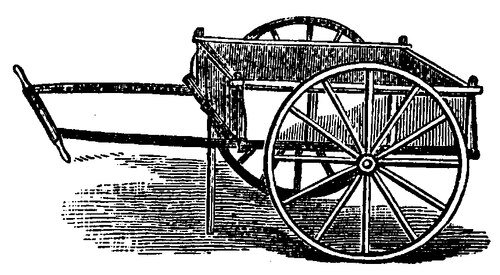
Actually using a dump cart involves three movements: backing to the drop point, releasing the bed, and pulling forward to clear the load. Carts that dump well let you do all three without getting off the tractor. Carts that dump badly require you to walk round, lift the bed by hand, or shovel out the front.
Practise the sequence in your head before buying. If the tailgate must be removed, if the latch is under the bed where you cannot reach it while seated, or if the tongue cannot be uncoupled from the bed, the cart will be more work than the wheelbarrow it replaced.
Maintenance that keeps it rolling
- Grease or oil the axle and the pivot at least twice a season.
- Check tyre pressure monthly if the wheels are pneumatic; low pressure is the usual cause of a cart that feels heavy.
- Touch up paint chips on steel beds before rust spreads under the coating.
- Store the cart tipped up or under cover, because a bed that holds rainwater rusts from the inside.
- Check the hitch pin and the tongue bolts after every heavy load; vibration loosens them.
If you want the specific models compared on load rating, tipping design and axle quality rather than catalogue claims, the review of the best dump cart for lawn tractor use sets them out side by side.
Loading and using the cart without wrecking it
Load the cart with the heaviest material low and toward the axle rather than up at the front of the bed. A load piled forward of the axle loads the tongue, and a tongue carrying real weight is hard to steer and hard to unhitch. Spread dense material like soil or gravel evenly and keep the total under the practical limit for wet material rather than the dry rating on the label.
Before dumping, check the ground behind the cart. A full bed released on a slope will slide, and the cart will follow it if the tongue is still coupled. Dump on level ground with the tractor braked, and pull forward slowly once the bed is empty rather than driving off with the bed still tipped.
Never use a dump cart as a passenger seat, and never load it with anything that can shift suddenly while moving. A cart with a high centre of gravity on uneven ground will tip, and a lawn tractor has no roll protection.
Maintenance schedule that keeps it rolling for years
- Weekly in season: check tyre pressure, check the hitch pin and the tongue bolts.
- Monthly in season: grease the axle and the tip pivot.
- Autumn: touch up paint on steel beds, wash out the bed, and check wheel bearings for play.
- Winter: store tipped up, under cover, with the tyres off the ground if possible.
- Annually: inspect the frame for cracks around the tip pivot and the axle mounts, which is where fatigue shows first.
Alternatives worth considering
A wheelbarrow is cheaper, needs no towing and is better in tight spaces, but it moves far less per trip and is hard work on soft ground. A garden trailer is larger and stronger, and costs considerably more. A utility cart with a removable bed is more flexible if you also want to move tools and long items. For most suburban properties, a dump cart sized to the lawn tractor is the best compromise between capacity, effort and cost, and the two features that decide whether you will still be using it in five years are the axle bearings and the tipping geometry.